AI job matching platform vs job boards for engineers
An AI job matching platform earns its place over a job board only if it filters to a few real fits with pay ranges shown. Here's how Prepin handles it.
 Prepin Founder6 min read
In short
An AI job matching platform beats a job board when it does the filtering for you, shows the posted pay range on every match, and leaves the decision to send an introduction in your hands. A board publishes everything and makes you the filter. Prepin surfaces 3 to 5 strong fits and sends nothing until you approve it.
An AI job matching platform beats a job board for engineers only when it filters down to a few real fits with pay ranges shown. Prepin does that, and sends nothing to an employer until you approve it.
A job board hands you the haystack. You are still the filter. Prepin is built for the other half of the work, the part where a backend, platform or ML engineer targeting $150K and up wants 3 to 5 strong fits and no scrolling.
What does an AI job matching platform do that a job board doesn't?
It does the filtering for you. An AI job matching platform is a candidate service that scores open roles against a structured profile and shows you only the ones that clear your bar. A job board is a listing site that publishes every open req and leaves the sorting to whoever is searching. Same jobs, opposite division of labor.
The distinction matters more for senior engineers than for anyone else. Your skills don't fit neatly into the keyword box a board search uses, so a query for platform engineer returns everything from junior DevOps to staff-level infra. Prepin's agent works from one voice conversation about goals, strengths and dealbreakers, then matches on that. We covered the full mechanics in what an AI job search agent does in 2026.
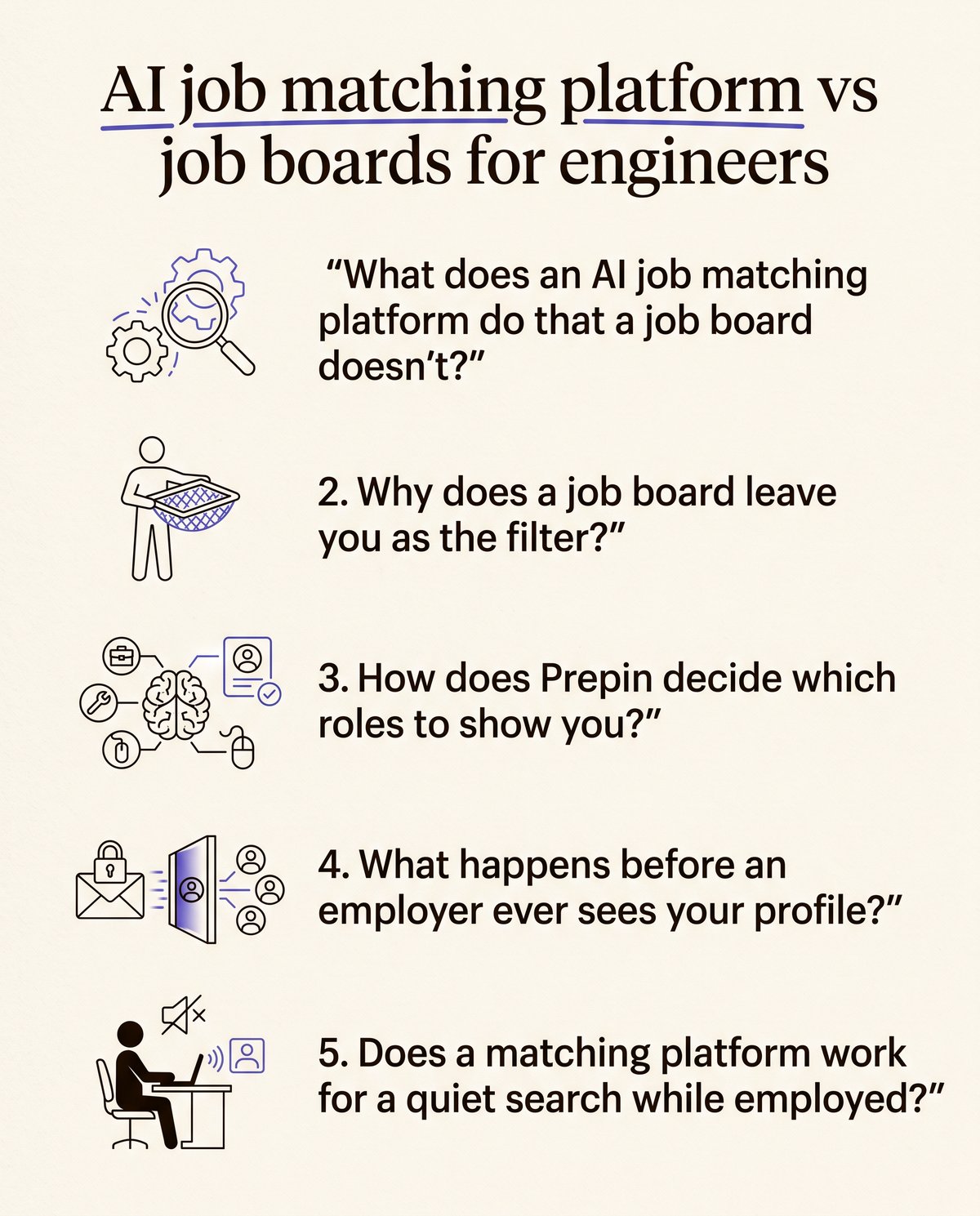
Why does a job board leave you as the filter?
Because a board's product is the listing count, and yours is your time. A board earns when employers post and when you click, so a bigger pile is a feature from its side of the table. Your side of the table gets a search bar and a saved filter that still returns a pile of near misses.
Then comes the second cost. Each near miss is a form you fill by hand, and every board asks for the same resume in a slightly different shape. If you've wondered why there are no replies after applying to 200 jobs, the answer usually starts with the fact that the board never checked fit before you hit submit. We wrote about the rising cost of each application in why it's getting harder to apply for jobs in 2026.
How does Prepin decide which roles to show you?
From a living profile built out of three sources. A living profile is a candidate profile that keeps updating from your conversation, your LinkedIn and your resume instead of freezing into one PDF. The agent runs three workflows against it. Best-fit role matches, recruiter outreach, and interview practice.
Setup is deliberately short. You tell the agent your location mode, whether remote, hybrid, onsite or specific cities, and a compensation floor. A compensation floor is a search setting that hides every role whose posted range sits below your minimum. After that, matches land in a weekly inbox showing company, location and the posted compensation range, and you review them rather than hunt for them.
| What Prepin uses | Detail |
|---|---|
| Profile sources | One voice conversation, LinkedIn, resume |
| Workflows | Best-fit matches, recruiter outreach, interview practice |
| Search settings | Location mode (remote, hybrid, onsite, specific cities) and a compensation minimum |
| What the inbox shows | Company, location, posted compensation range |
| Sending rule | Nothing goes out without your approval |
| Interview practice | Coding, system design, behavioral |
There's one more step before a recruiter sees anything. The agent runs a profile weakness review, so the gap a recruiter would spot is one you've already seen and fixed. Skill checks and assessment evidence sit next to the profile too, which gives a hiring manager something firmer than a resume bullet.
What happens before an employer ever sees your profile?
You press approve, or you don't. Every employer introduction on Prepin is a decision you make, one at a time, and the intro goes out by email only after that. We put it plainly on the site: "It never auto-applies or sends your profile without your permission."
This is the line that separates a matching platform from an auto-apply tool. Auto-apply is a job search tool that submits your resume to listings on your behalf without a per-role decision from you. Some of those tools fire off applications by the hundred, and the candidate learns which companies got their name when the rejections arrive. Prepin has no such button.
Does a matching platform work for a quiet search while employed?
Yes, and that's the case where the approval step earns its keep. A job board profile set to visible is visible to your current employer's recruiters as well. On Prepin, no employer sees you until you've looked at the role and said yes to that specific intro, so a quiet search stays quiet.
Also, a matching platform only helps here if the inbox is small enough to review in the gaps of a working week. That's why we position the best use as finding 3 to 5 strong fits. A long list gets skimmed. A short one gets read.
How do job boards, mass-apply bots, recruiters and matching platforms compare for senior engineers?
A matching platform wins when the question is offer quality per hour spent, and a good recruiter comes close if you happen to have one. Boards and bots optimize for volume, which is the wrong metric once you're past mid-level. Here's the honest side-by-side.
| Option | Who does the filtering | Comp range visible before you act | Who decides an employer sees you | Best for |
|---|---|---|---|---|
| Job board | You | Sometimes, depends on the posting | You, on each form | Early-career or exploratory searches |
| Mass-apply bot | Nobody | Rarely checked | The bot | Volume, at the cost of your reputation |
| Third-party recruiter | The recruiter | Usually, once they call | The recruiter | Candidates with an existing relationship |
| Prepin | The agent, from your profile | Yes, in the inbox for every match | You, per introduction | Senior engineers who want a few real fits |
The volume column is the one people underrate. We put mass applying and targeting side by side in mass applying vs targeting 10 roles a week if you want the longer argument. Bots also carry a reputational cost a board doesn't, since a hiring manager who gets the same template application twice tends to remember the name.
When is a job board still the right tool?
When you don't yet know what you want. A board is good at showing you the shape of a market, which titles exist, what a staff platform role in a given city lists for pay, and who's hiring at all. Browsing is research, and research is fine. Our August 2026 tech jobs report is that kind of research.
Prepin assumes you've done that part. If you'd rather scroll a big list and apply broadly, we're a poor fit, and we'd rather say so than sign you up. Where a board stops being useful is the moment you've narrowed to remote platform or ML work above your floor and want the few roles that match to come to you.
How do you start with Prepin?
With one conversation, spoken, about what you want and what you'd refuse. No forms and no resume parsing wizard. The agent turns that into a profile a recruiter can read, pulls in your LinkedIn and resume, and starts surfacing matches with the pay range shown for each one.
Every intro still waits on your approval, and interview practice for coding, system design and behavioral rounds is there before your first real loop. You can start the conversation at prepin.ai and read the first matches before deciding whether any of them deserve an introduction.
Frequently asked questions
- Do I still need a resume if Prepin builds my profile from a conversation?
- Bring one, but it stops being the main event. Prepin folds your resume and LinkedIn into the profile alongside the voice conversation, so the structured profile a recruiter reads is richer than the PDF alone. Skill checks and assessment evidence sit next to it too, which means a claim on the resume has something behind it.
- What happens when I decline an introduction on Prepin?
- Nothing leaves the building. The employer never receives your profile, and the intro email is never sent, because every introduction on Prepin waits on your approval. Declining is a normal part of the loop rather than a failure. Use it freely, since the point of a small inbox is that you can afford to read each role and say no to most of them.
- Can I practice system design and behavioral interviews inside Prepin before a real loop?
- Yes. Interview practice is one of the agent's three workflows, and it covers coding, system design and behavioral rounds. The idea is to run the awkward first attempt with the agent rather than with the hiring manager at a company you actually want. Practice sits alongside matching, so you can rehearse for the specific kind of role that's showing up in your inbox.
- Is Prepin a good fit if I want to apply to hundreds of jobs quickly?
- No, and we'd rather tell you now. Prepin has no auto-apply and no mass submission feature, and it never sends your profile anywhere without your approval. If your plan is volume, a job board plus a bot will get you there faster. Prepin is for candidates who want a handful of strong-fit introductions and full control over which employers see them.
- #ai job matching platform
- #job boards
- #job search tools for software engineers
- #platform engineer
- #no auto apply job search
Keep reading
Job search tools for software engineers, compared
Job search tools for software engineers fall into four categories, from trackers and ATS scanners to auto-apply bots and candidate agents. Which fits you?
· 6 min read
August 2026 tech jobs report: who's hiring engineers
The August 2026 tech jobs report: tech occupations up 86,000, tech firms down 14,700. Where senior backend, platform and ML roles moved, and how to find them.
· 7 min read
Mass applying vs targeting 10 roles a week
Mass applying vs targeting 10 roles a week is a real choice. Prepin screens roles against your constraints and holds every introduction until you approve.
· 4 min read
What an AI job search agent does in 2026
An AI job search agent finds roles that fit and skips the ones that don't. Prepin screens against your constraints and holds every intro until you approve.
· 4 min read