What an AI job search agent does in 2026
An AI job search agent finds roles that fit and skips the ones that don't. Prepin screens against your constraints and holds every intro until you approve.
 Prepin Founder4 min read
In short
An AI job search agent builds a profile of you, screens open roles against your constraints, and returns a short list rather than a feed. Prepin runs that loop from one intake conversation, merges LinkedIn and your resume into the profile, and holds every recruiter introduction until you approve it.
An AI job search agent reads your background, screens open roles against your constraints, and hands you a short list instead of a feed. Prepin adds one rule most of them skip. No introduction goes out until you say yes.
That rule is the whole argument. Plenty of tools in this category will go find roles for you. Far fewer will stop and wait for a human before a company sees your name.
What does an AI job search agent actually do?
It builds a picture of you, screens open roles against that picture, ranks whatever survives, and gets you ready for the interviews that follow. Four steps. Most tools do one or two of them and call it a search.
Screening is the step people rush past. Everything downstream depends on it, because a carefully tailored application to a role that was never going to work is still a wasted evening. If the filter is loose, you're just reading a feed with extra steps. Two hundred applications and no replies usually means the roles never fit in the first place.
| Piece | How Prepin handles it |
|---|---|
| Profile intake | One voice conversation covering goals, strengths, and dealbreakers |
| Profile sources | LinkedIn, resume, and the conversation, merged into one structured profile |
| Match volume | A handful of strong fits per role type, best used to find three to five |
| Recruiter intros | Each one waits for your approval before it's sent |
| Auto-apply | None, and no mass applications |
| Interview practice | Coding, system design, and behavioral |
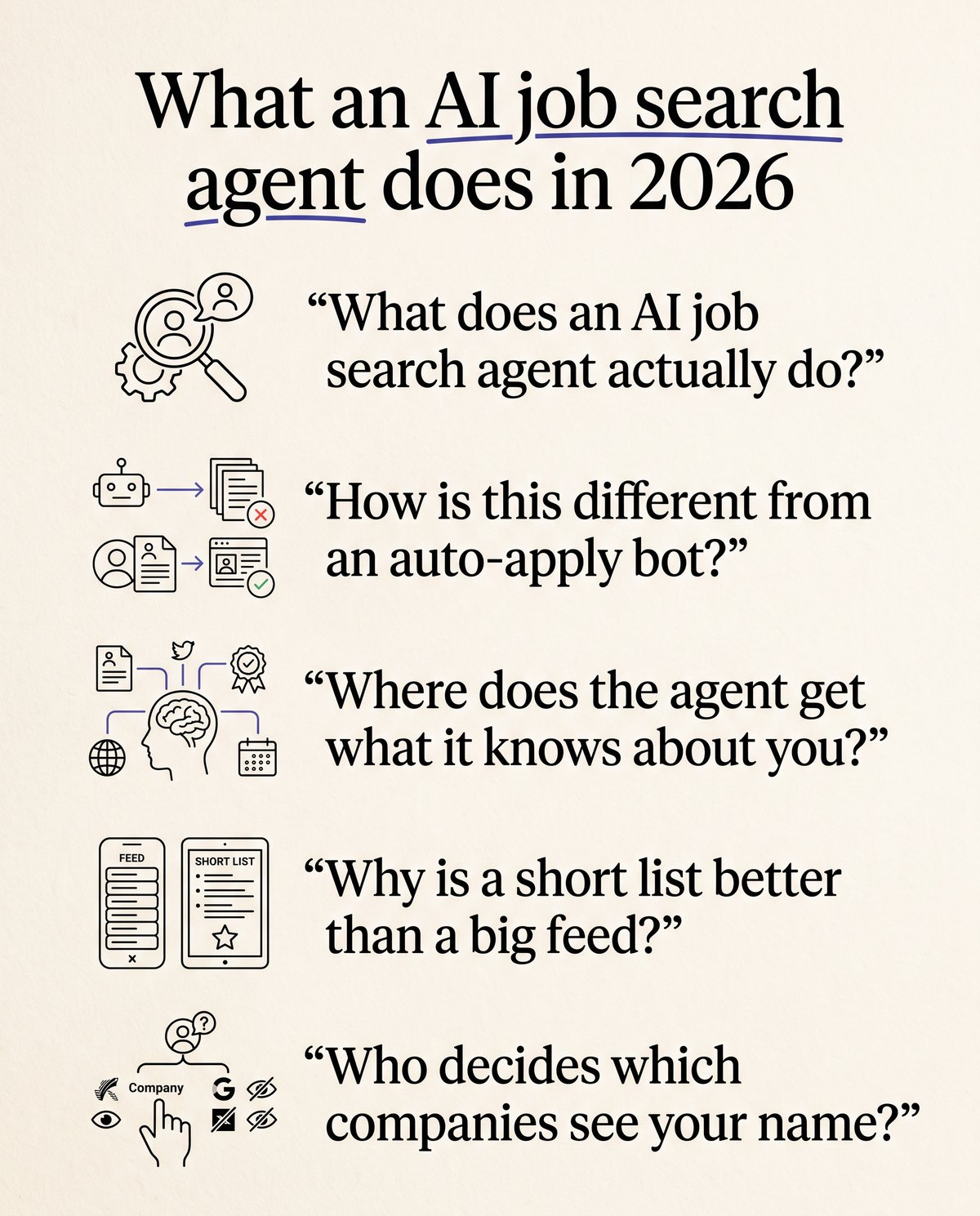
How is this different from an auto-apply bot?
Direction of the effort. A bot's job is to raise your submission count, so it optimizes for forms filled per hour. An agent's job is to raise the odds that any single conversation goes somewhere, so it optimizes for what it throws away.
Prepin has no auto-apply and no mass applications, and there's no setting to switch that on. If you've watched a bot fire off ninety applications overnight and produce three rejections and silence, you already know why the two designs feel different from the inside. We went through the tradeoff in detail in the case against auto apply bots and again in Prepin vs LazyApply.
Where does the agent get what it knows about you?
From one conversation, plus the two documents you already have. Prepin's intake is a voice conversation covering goals, strengths, and dealbreakers. No forms. Nothing starts with a parser guessing at your resume formatting.
After that, LinkedIn, your resume, and the conversation merge into a single structured profile. Three sources, three workflows. The profile also holds preferences and avoid-lists, the kind of thing that never fits on a resume, like remote-first or no maintenance roles. Skill checks and evidence back it up rather than resume claims alone, and because the profile stays living, you can review what looks weak before a recruiter reads it.
Why is a short list better than a big feed?
Because you'll actually finish reading it. Prepin's stated best use is finding three to five strong fits, and the weekly view is a handful of strong fits per role type. That's a list you can work through in one sitting.
Three roles you can research properly beat three hundred you skim. Filters handle the rest of the narrowing, remote or hybrid or onsite, plus a compensation floor you set once instead of re-typing into every board. You can track and archive roles as you decide, so the same posting doesn't resurface a week later wearing a different title. That arithmetic is the same one behind targeting ten roles a week.
Who decides which companies see your name?
You do, every time. Each introduction waits for your approval before it goes out, so no company sees your profile because a scoring function liked the keyword overlap.
This matters most if you're employed and would rather your current team not find out. A search that stays quiet is a search you can run for months without a rushed decision. Prepin vs Simplify walks through where the approval step sits compared to a tool built around autofill.
Does an AI job search agent help after the match?
Yes, and this is where most of the category stops. Prepin's interview practice covers coding rounds, system design, and behavioral questions, so the prep isn't a separate subscription you remember to buy the night before a loop.
The profile review does similar work earlier. Finding out your last two years read as vague is much cheaper on your own time than in a screen with a recruiter who has forty other candidates.
Who should skip an agent like this?
Anyone who wants volume. If you're after auto-apply, bulk submissions, or a passive resume blast with no review step, this is the wrong tool and you'll notice fast.
Same goes if you want a recruiter-led process where someone else decides which roles you see. And if sitting through one intake conversation sounds like too much, nothing downstream works, since that conversation is what the matching runs on. Those are real disqualifiers, not fine print.
If the shape of search you want is a few roles worth reading and a hard stop before anything goes out, start the intake conversation at prepin.ai.
Frequently asked questions
- Does an AI job search agent apply to jobs for me?
- Prepin doesn't. There's no auto-apply and no mass applications. The agent surfaces a short list of matched roles and drafts introductions, then stops. Each introduction waits for your approval before it reaches a recruiter, which means the number of companies that see your profile is a number you chose rather than one a bot ran up overnight.
- How long does the setup take?
- One conversation. Prepin's intake is a voice conversation covering your goals, strengths, and dealbreakers, with no forms to fill and no resume upload as the starting point. From there, your LinkedIn, your resume, and that conversation merge into one structured profile, including preferences and avoid-lists like remote-first or no maintenance roles.
- How many matches should I expect?
- A handful of strong fits per role type in the weekly view, with three to five strong fits described as the best use of the tool. The point is a list short enough to research properly. You can filter by remote, hybrid, or onsite and set a compensation floor, then track or archive roles as you decide on each one.
Keep reading
Job search tools for software engineers, compared
Job search tools for software engineers fall into four categories, from trackers and ATS scanners to auto-apply bots and candidate agents. Which fits you?
· 6 min read
AI job matching platform vs job boards for engineers
An AI job matching platform earns its place over a job board only if it filters to a few real fits with pay ranges shown. Here's how Prepin handles it.
· 6 min read
A better alternative to auto apply bots
Looking for an alternative to auto apply bots? Prepin screens roles against your constraints and holds every introduction until you approve it yourself.
· 4 min read
Mass applying vs targeting 10 roles a week
Mass applying vs targeting 10 roles a week is a real choice. Prepin screens roles against your constraints and holds every introduction until you approve.
· 4 min read