Resume weakness review before a recruiter reads it
A resume weakness review flags thin evidence and vague claims before any recruiter sees your profile. Here's how Prepin does it, and what to fix first.
 Prepin Founder6 min read
In short
A resume weakness review flags thin evidence and vague claims before any recruiter reads your profile, so you fix gaps before they cost you replies. Prepin builds your profile from one voice conversation plus LinkedIn and resume, reviews it for weak spots, keeps assessment evidence alongside it, and sends no introduction until you approve it.
A resume weakness review from Prepin flags thin evidence and vague claims in your profile before any recruiter reads it, so you fix the gap on your terms instead of hearing about it through silence.
Silence is the worst feedback in hiring. You learn something's off and nothing about what, and you only learn it after the weak version of your profile has already gone out.
What does a resume weakness review catch?
A resume weakness review catches the lines a recruiter skims past because nothing backs them up. Think thin evidence, vague claims, and a gap between the role you want and the story your work history tells.
Put plainly, a resume weakness review is a pre-send check that reads your profile the way a recruiter would and marks what won't survive a skim. On engineering profiles, the usual weak spots look like this.
- Improved performance with no system named, no scale and no before or after.
- A senior title sitting on bullets that read like a ticket queue.
- Tool names doing all the work. Kubernetes, Kafka and PyTorch show what you touched and say nothing about what you decided.
- Dealbreakers like remote-only or a comp floor that live in your head and nowhere on the page.
- Skills listed with nothing to check them against, like an assessment result or a shipped outcome.
None of these reads as disqualifying on its own. Stacked together, they make a strong engineer look interchangeable.
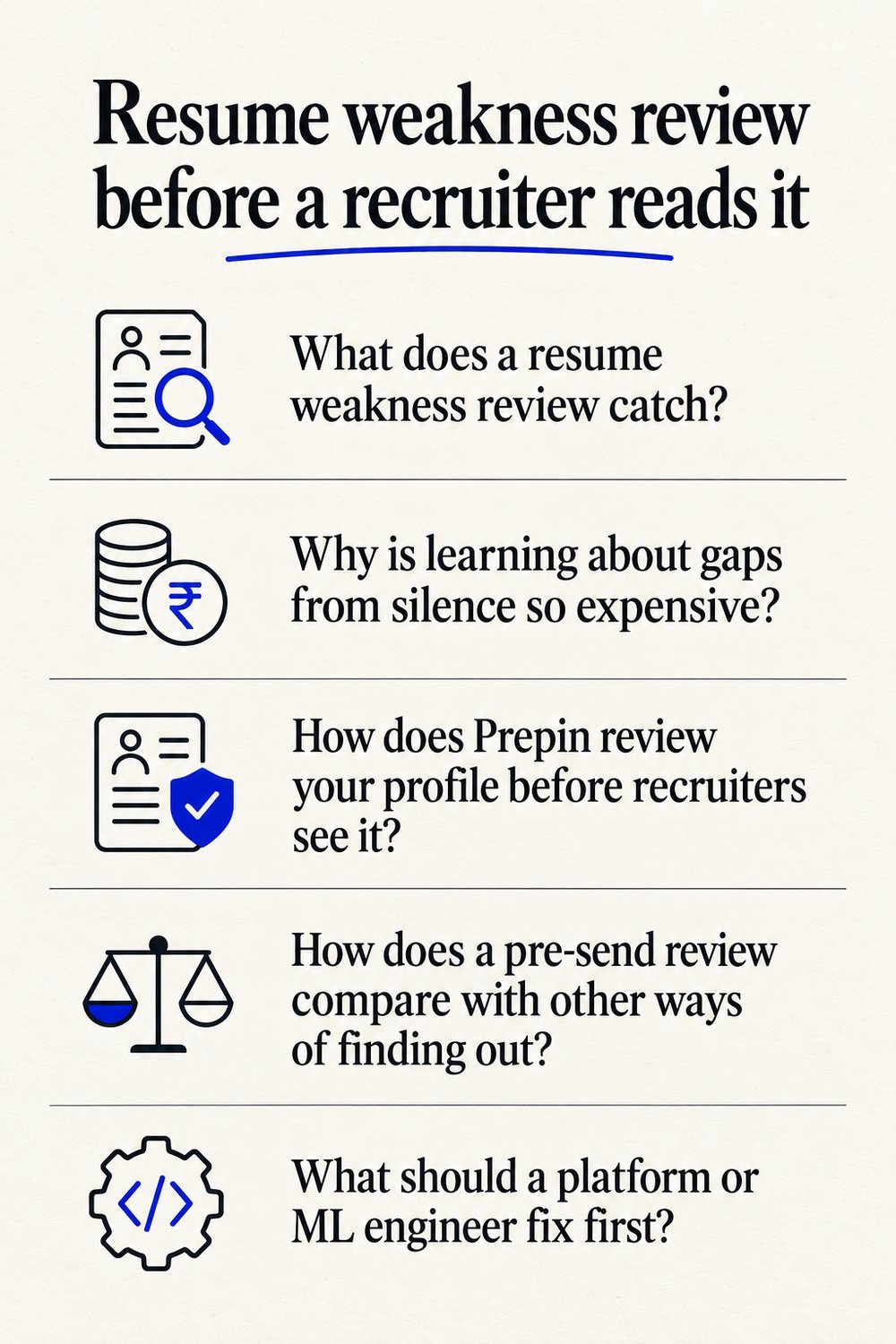
Why is learning about gaps from silence so expensive?
You find out late, you find out nothing specific, and every employer already saw the weak version. A rejection at least closes a door. Silence doesn't even tell you which door.
Auto-apply is a tool category that submits applications in bulk on your behalf, often to roles you never read. Pair it with a thin profile and the math gets ugly fast. Two hundred sends of the same vague bullets produce two hundred silences, and you still don't know which line cost you. We walked through why replies dry up after mass applying in more detail.
How does Prepin review your profile before recruiters see it?
Prepin builds your profile first, reviews it for weak spots, and only then shows you matches you can choose to be introduced to. Nothing reaches an employer until you press approve.
A candidate agent is an AI assistant that works for the job seeker, building the profile, finding matches and preparing introductions you sign off on. Here's the order Prepin works in.
- You have one voice conversation about your goals, strengths and dealbreakers. No forms.
- Prepin combines that conversation with your LinkedIn and resume into one structured candidate profile.
- The profile weakness review flags thin evidence and vague claims before any recruiter sees the profile.
- Skill checks and assessment evidence sit alongside the profile, so a claim can point at proof instead of standing alone.
- Matched roles land in your inbox with company, location and posted compensation range. You approve or decline every introduction.
Prepin's agent panel shows 3 sources and 3 workflows. Those workflows are best-fit role matches, recruiter outreach and interview practice. For the long version of who sees what and when, read how your profile stays visible on your terms.
How does a pre-send review compare with other ways of finding out?
A pre-send review is the one route here where you learn about the gap before any employer sees your profile.
| Route | When you learn about a weak spot | What you learn | Who saw the weak version |
|---|---|---|---|
| Prepin weakness review | Before any introduction goes out | Which claims lack evidence | Nobody yet |
| Auto-apply or mass applications | After replies fail to arrive | Nothing specific | Every employer it reached |
| Open profile on a job board | When recruiter messages stop or miss your level | You guess from the mismatches | Anyone searching the board |
| Recruiter phone screen | Mid-call, when a claim gets probed | One gap at a time | That recruiter and their client |
LinkedIn's move to AI job search is one more reason to tighten the page, and we covered what that switch means for engineers. Whatever engine reads your profile, a vague claim gives it less to match on.
What should a platform or ML engineer fix first?
Fix the claims a recruiter would have to verify on a phone screen. Those are the ones that stall a loop before it starts.
For a platform engineer resume, that usually means naming the platform, who used it and one decision you made about it. Same for a machine learning platform engineer: the training or serving system, the teams on it, the tradeoff you owned. Tool lists don't count.
Here's an illustrative rewrite with no metrics invented.
- Weak version. Worked on Kubernetes infrastructure for ML teams.
- Stronger version. Moved batch training jobs onto a shared cluster and wrote the scheduling rules other teams now use.
The stronger line has no number in it, and it still beats the weak one. A recruiter can ask about it. Add a real metric only if you have one you can defend.
Does a clean profile matter if you only want 3 to 5 roles?
It matters more. Prepin's best use is finding 3 to 5 strong fits, and with that few introductions, every vague line takes a bigger bite out of your odds.
Three roles that fit beat a pile of applications that vanish. You set location mode once (remote, hybrid, onsite or specific cities) along with a compensation minimum, then review matches instead of scrolling boards. If you're aiming at $150K+ remote or hybrid roles, set that floor first.
A quiet search raises the stakes again. While you're employed, you want a sharp profile in front of a few employers you picked, and nowhere else. Here's how a passive search stays quiet.
How do you turn flagged weaknesses into interview prep?
Treat every flagged line as a question you'll get in the loop. If a claim is thin on the page, an interviewer will probe it live.
Prepin's interview practice covers coding, system design and behavioral rounds. A vague scaling claim is a system design prompt waiting to happen. A fuzzy leadership bullet is a behavioral question.
Practice the weak spots first. That way the first time you explain a hard tradeoff out loud isn't the real loop.
Is a review-first agent safer than an AI apply bot?
Yes, for anyone who cares which employers see them. An apply bot is built for volume, while a review-first agent is built around fit, with you holding the approve button.
Prepin's rule is short. "It never auto-applies or sends your profile without your permission." Each introduction waits for your approval, and you can decline any of them.
Start with one conversation at prepin.ai. It becomes a profile built from LinkedIn, your resume and what you said, checked for weak spots, and it goes nowhere until you approve an introduction.
Frequently asked questions
- Can I fix weak spots before Prepin introduces me to anyone?
- Yes. The profile weakness review runs before recruiters see your profile, and no introduction goes to an employer until you approve it. That gives you room to add evidence, like a skill check or assessment result, or tighten a vague claim, before the first employer ever reads your name.
- Do I have to fill out forms to build a Prepin profile?
- No. Prepin starts with one voice conversation about your goals, strengths and dealbreakers. It then combines that conversation with your LinkedIn and resume into one structured candidate profile. You talk through what you want once, and the living profile keeps it, so you aren't retyping the same details into application forms.
- Will Prepin send my profile out while I'm still employed?
- Not without you. Prepin never auto-applies and never submits in bulk. Every employer introduction needs your approval first, so a quiet search stays quiet. You pick which matches move forward, each shown with company, location and posted compensation range, and you can decline the rest without that employer receiving your profile.
- Can I set a minimum salary before reviewing any matches?
- Yes. Search setup asks for a location mode (remote, hybrid, onsite or specific cities) and a compensation minimum. After that you review matched roles in your inbox, each with its company, location and posted compensation range, so you can judge pay before deciding whether an introduction goes out.
- What counts as evidence on a Prepin profile?
- Skill checks and assessment evidence sit alongside your profile, so your strongest claims can point at something a recruiter can check. That matters most for senior backend, platform and ML roles, where a list of tools says little about what you built or decided. The weakness review shows which claims still need that backing.
- #resume weakness review
- #job search tools for software engineers
- #candidate profile
- #auto apply job alternative
- #interview practice
Keep reading
September 2026 jobs report: postings up, hiring down
The September 2026 jobs report shows tech postings at a three-year high while tech jobs fell. Here's what senior engineers should do instead of mass applying.
· 5 min read
A candidate profile recruiters can see, on your terms
A candidate profile recruiters can see works best when it's built from one conversation. Prepin combines LinkedIn, resume and voice, and holds each intro.
· 4 min read
August 2026 tech jobs report: who's hiring engineers
The August 2026 tech jobs report: tech occupations up 86,000, tech firms down 14,700. Where senior backend, platform and ML roles moved, and how to find them.
· 7 min read
LinkedIn AI job search replaces classic: what now?
LinkedIn AI job search is replacing classic keyword search with no salary filter. What changes for engineers, and why Prepin's pay floor and approve step help.
· 7 min read