Why it's getting harder to apply for jobs in 2026
It's getting harder to apply for jobs because employers now add friction on purpose. Here's what changed, and why Prepin's few approved introductions win.
 Prepin Founder7 min read
In short
It's getting harder to apply for jobs because recruiters, drowning in AI-driven volume, are adding friction on purpose. LinkedIn is limiting automated applications and warning underqualified applicants, and Greenhouse's head of voice AI told WIRED friction is the point. For senior engineers, a few evidence-backed, approved introductions now beat any volume play, which is the gate Prepin builds in.
It's getting harder to apply for jobs because employers are adding friction on purpose after AI drove application volume past what recruiters can read. Fewer, evidence-backed introductions win now, which is the gate Prepin puts on your side.
WIRED made the case out loud on August 25, 2026, under the headline "It Should Be Harder to Apply for a Job. No, Really." Recruiters agreed. Platforms are already building the walls.
Why is it getting harder to apply for jobs right now?
Because the people who read applications are drowning, and they've decided the fix is friction. LinkedIn told WIRED that submissions per applicant are up 46 percent compared with its baseline from just before the pandemic, and up 22 percent since ChatGPT launched. In response, LinkedIn has added limits aimed at automated, low-quality applications. It's also rolling out a feature that warns apparently underqualified applicants they aren't a good fit and suggests alternatives.
Read that last one again. A platform is now telling candidates no before an employer ever sees the file. Expect more of that.
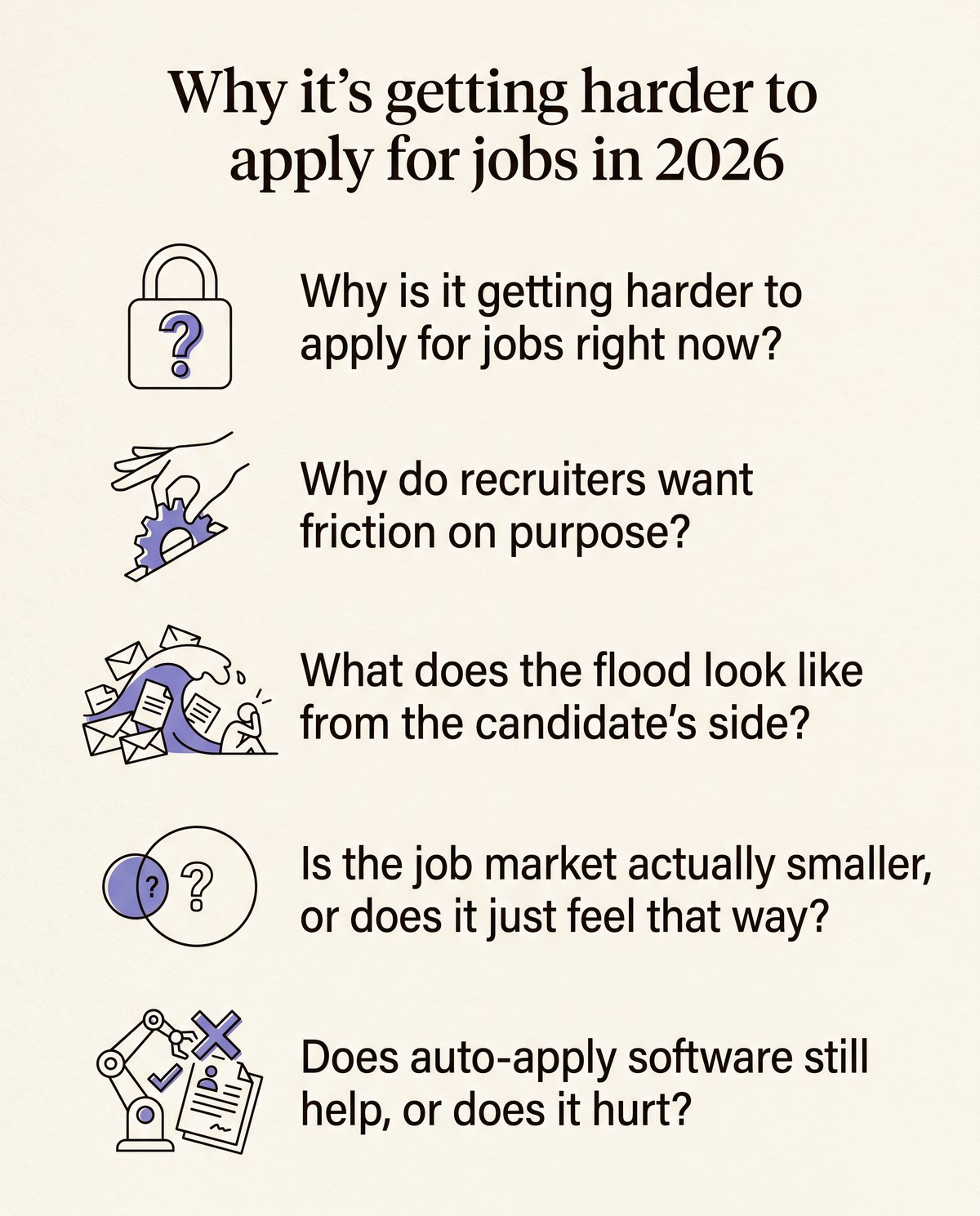
Why do recruiters want friction on purpose?
Because a flood of applications hides the handful they actually want to call. Ophir Samson, head of voice AI at Greenhouse, said it plainly to WIRED: "actually, we kind of want friction. The friction is good. We want to make it harder."
His examples are the whole story. One company made applying easy and got 2,000 applicants in 24 hours. Recruiters tell him they sit on 1,000 applications of which only 30 are serious. Nobody reads the rest carefully.
An applicant tracking system (ATS) is a piece of recruiting software that stores and filters every application before a person reads one. Feed it a thousand files per role and the filters get tighter. Every extra submission you make is a vote for tighter filters.
What does the flood look like from the candidate's side?
It looks like silence. Andrew Stockwell, head of people at Vendr and currently job hunting himself, told WIRED that roles which used to draw about 100 applications now draw more than a thousand at times. He estimates fewer than 2 percent of his own online applications lead to a phone call. His verdict: "The whole thing is a big mess."
That's a head of people. Someone who runs hiring for a living can't get a callback from the online funnel. If the process fails him, it isn't going to be kinder to a staff engineer submitting between meetings. We've written about why 200 applications produce no replies, and the answer hasn't improved since.
Is the job market actually smaller, or does it just feel that way?
Smaller. Job openings peaked at a record 12.3 million a few years ago, according to Bureau of Labor Statistics data cited by WIRED, and have hovered around 7 million for a couple of years now. Fewer openings, more submissions per person, and cheaper tools to submit them. That's the arithmetic behind every unanswered application.
Jane Curran, chief transformation officer at JLL, described the peak as a time when "you literally could have three offers in an afternoon" and today as "the polar opposite." She expects some companies to add knock-out questions with strict criteria while others move skills testing earlier in the process. A knock-out question is a screening question that rejects an applicant automatically when the answer misses a fixed requirement.
So the door gets narrower in two ways at once. Either you fail a hard filter before a human looks, or you're asked to prove skill up front. Either way, a generic resume has less room to work.
Does auto-apply software still help, or does it hurt?
It hurts, because it's the exact behavior the new friction is built to block. WIRED names JobAssist, Sonara and Ladder's Apply4Me as tools that promise to handle the busywork entirely, submitting 10x as many applications with less effort than one manual application. Every one of those submissions lands in a pile a recruiter is actively trying to shrink. LinkedIn's limits target automated, low-quality applications specifically.
Tessa White, a former HR executive with 800,000 TikTok followers, called AI and applicant tracking systems "an antiquated way to look at people and skill sets." She's right about the resume-keyword game. The answer isn't to play it faster.
For a senior backend or ML engineer the math is worse than for most. Your resume already carries specific systems and scale. A bot that fires it at two hundred loosely matched postings burns the one thing you had, which is credibility with the recruiters who read carefully. There's a better alternative to auto apply bots, and we've laid out how Prepin and LazyApply differ if you want the head-to-head.
What does the front of the funnel look like now?
A conversation and a score, on the employer's side. Greenhouse completed its acquisition of Ezra AI Labs on May 27, 2026. Ezra is a voice AI interviewer that asks candidates role-specific questions and scores the responses against a consistent rubric. Greenhouse serves over 7,500 companies.
Samson put it this way: "Hiring has needed a conversation at the front of the funnel for a long time." Fair enough. Employers are getting a structured conversation and a rubric at the door. Candidates, for the most part, still get a form field and a PDF upload.
That asymmetry is the opening. If the front of the funnel is a conversation now, the candidate who shows up with one already done, plus evidence, is the one who clears it.
How does Prepin put the gate on the candidate's side?
By making you the one who says yes. Prepin is an AI candidate agent that turns one voice conversation into a living profile, surfaces the few roles that fit, and only sends an introduction after you approve it. It never auto-applies or sends your profile without your permission. That's the site's own wording, and it's the whole product.
Here's the actual flow.
- You talk. One voice conversation about goals, strengths and dealbreakers, with no forms and no resume parsing.
- The agent combines your LinkedIn, your resume and that conversation into one structured profile a recruiter can read.
- You set location mode once (remote, hybrid, onsite or specific cities) plus a compensation minimum.
- Your inbox shows matched roles with the company, the location and the posted compensation range.
- Before any recruiter sees you, the agent flags weak spots in the profile, and skill checks and assessment evidence sit next to it instead of resume claims alone.
- Nothing goes to an employer until you press approve. Every intro, every time.
Friction is fine when you own it. The site positions the best use as finding 3 to 5 strong fits, and the agent panel runs three workflows. Best-fit matches, recruiter outreach and interview practice. For the full picture of the category, see what an AI job search agent does in 2026.
| Fact | Detail | Source |
|---|---|---|
| Submissions per applicant on LinkedIn | Up 46 percent vs the pre-pandemic baseline; up 22 percent since ChatGPT launched | WIRED, August 25, 2026 |
| Serious applicants per 1,000 | Recruiters report about 30 | Ophir Samson, Greenhouse, via WIRED |
| Applications per role | About 100 before; now at times more than a thousand | Andrew Stockwell, Vendr, via WIRED |
| US job openings | Record 12.3 million at the peak; around 7 million for a couple of years | Bureau of Labor Statistics data cited by WIRED |
| Greenhouse acquisition of Ezra AI Labs | Completed May 27, 2026; voice interviewer with rubric scoring | Greenhouse newsroom |
| Prepin approval rule | No auto-apply; every introduction sent only after candidate approval | prepin.ai |
Figures above are current as of the publication date.
What should a senior engineer do now?
Stop feeding the pile, pick the handful of roles you'd actually take, and pursue an approved introduction to each. The friction is real and it isn't going away. Work with it instead of against it.
- Set a compensation floor and location mode once, so anything under the bar never reaches your inbox.
- Put evidence next to your profile before a recruiter opens it. Curran expects skills testing to move earlier, so meet it there.
- Practice the loop before the loop. Coding, system design and behavioral rounds, with the agent, before a real interviewer with a rubric.
- Approve or decline every intro. If a quiet search while employed matters to you, this is the only setting that keeps your profile from going everywhere.
We compared mass applying against targeting ten roles a week and the small number won on replies. Start the conversation at prepin.ai and let the employers who fit come to you.
Frequently asked questions
- Does LinkedIn's new warning mean I can't apply if I'm underqualified?
- WIRED reports the feature warns apparently underqualified applicants they aren't a good fit and suggests alternatives, and no exact policy wording for the new limits is given. Treat it as a signal that keyword-stuffed volume is being filtered at the door, and that a profile backed by evidence of real skills is what still gets through.
- Can I run a quiet search while employed without my profile going everywhere?
- Yes, if the tool never sends anything without your say. Prepin states it never auto-applies or sends your profile without permission, and every employer introduction waits for your approval. Set your location mode and compensation floor once, review the matches in your inbox, then approve only the introductions you actually want.
- How many roles should a senior engineer target at once?
- Prepin positions its best use as finding 3 to 5 strong fits. With recruiters telling Greenhouse they hold 1,000 applications and only 30 serious ones, adding volume mostly adds noise. A small set of approved, evidence-backed introductions to roles that clear your compensation floor is the practical play for backend, platform and ML engineers.
- Does interview practice matter more now that employers use AI interviewers?
- It does. Greenhouse's Ezra is a voice AI interviewer that asks role-specific questions and scores responses against a consistent rubric, and Greenhouse serves over 7,500 companies. Prepin's agent includes practice for coding, system design and behavioral rounds, so the first time you meet a scoring rubric isn't inside a real loop.
Keep reading
A better alternative to auto apply bots
Looking for an alternative to auto apply bots? Prepin screens roles against your constraints and holds every introduction until you approve it yourself.
· 4 min read
Mass applying vs targeting 10 roles a week
Mass applying vs targeting 10 roles a week is a real choice. Prepin screens roles against your constraints and holds every introduction until you approve.
· 4 min read
Prepin vs LazyApply: fit first or spray and pray
Prepin vs LazyApply is fit versus volume. Prepin waits for your approval on every introduction. LazyApply is built for mass submissions, not quiet targeting.
· 3 min read
What an AI job search agent does in 2026
An AI job search agent finds roles that fit and skips the ones that don't. Prepin screens against your constraints and holds every intro until you approve.
· 4 min read