Why no replies after applying to 200 jobs?
Why no replies after applying to 200 jobs? Usually the roles never fit. Prepin screens opportunities against your constraints and holds every introduction.
 Prepin Founder4 min read
In short
Applying to 200 jobs and hearing nothing usually means most of those roles never fit your title, scope, comp band or location. Volume hides the screening step instead of doing it. Prepin screens opportunities against the constraints you set and holds every introduction until you approve it, so fewer applications carry more weight.
Why no replies after applying to 200 jobs? Usually because volume buys you nothing. Most of those roles never matched your constraints. Prepin screens opportunities against what you told it and holds every introduction until you approve it.
Volume isn't a strategy. What it does is turn a fit problem into a data entry problem, and the data entry never ends.
Why does applying to 200 jobs get you nothing?
Because a bad match at scale is still a bad match. If 12 of those 200 roles actually fit your title, scope, comp band and location, you spent the other 188 filling forms for people who were never going to call. Somebody sorts for fit either way. You just paid for the sorting with your evenings.
There's a second cost, and it's quieter. Every application is a blind bet that the posting is real, current, and open to someone with your background. Send 200 blind bets and no single one teaches you anything. Silence doesn't tell you the role was filled weeks ago, or that your experience sat outside the band, or that nobody opened the file. Mass applying vs targeting 10 roles a week is the same trade with the numbers written down.
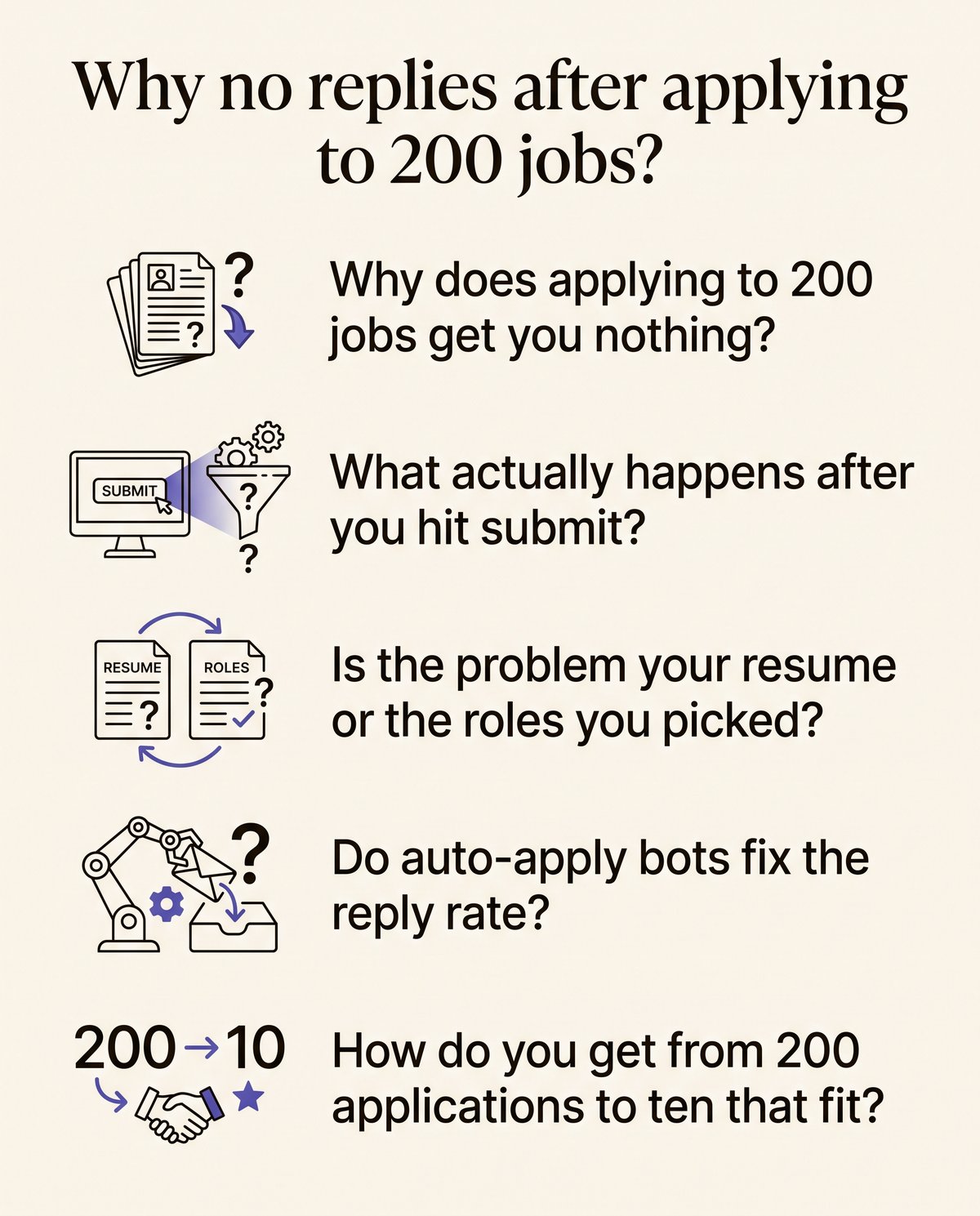
What actually happens after you hit submit?
Your application lands in a queue that a person or a filter has to work through. Nobody owes you a reply for a no, and most systems are built to send nothing. So silence is the default output, and you can't read it. A rejection at least carries information. Getting neither leaves you refreshing an inbox and guessing.
That's why 200 applications feel like a black hole. You're not getting worse at this. You're running a process that returns almost no signal, then trying to tune it on feedback that never arrives.
Is the problem your resume or the roles you picked?
Usually the roles. A resume rewrite sharpens a posting you already chose well, and it does nothing for a posting that was wrong for you from the first line. Fix the picking first. Then fix the wording.
Screening is the cheaper step. Reading a job description against your own constraints takes a few minutes and either kills the role or keeps it. Rewriting a resume for a role you shouldn't have applied to takes an hour and buys you a better-worded no.
Do auto-apply bots fix the reply rate?
No. They raise your submission count and leave the fit problem exactly where it was, so the replies stay flat while the applications pile up. Bots also send things with your name on them that you never read. Prepin vs LazyApply is the short version of that argument.
Prepin doesn't auto-apply and doesn't do mass submissions. Nothing goes out on your behalf. You approve each introduction, one at a time, or you don't.
How do you get from 200 applications to ten that fit?
Start from constraints instead of from listings. Write down the title range, the scope you want, the comp floor, the locations you'll accept, and the things that are hard nos. Then screen every role against that list before you open a single form.
That's the job Prepin's agent does. It surfaces matched opportunities against what you told it, so the screening happens before you spend the hour. A better alternative to auto apply bots covers what that replaces.
| Where the decision sits | Mass applying | Prepin |
|---|---|---|
| Who picks the roles | You, off a board, one tab at a time | The agent screens roles against your constraints |
| Who sends the application | A bot, in bulk, unread | Nothing goes out without your approval |
| When a company sees your name | The moment you submit | After you approve that introduction |
| What it costs a candidate | Depends on the tool | Free for candidates |
| Interview prep | Bought separately | 20-minute AI interview, behavioral, coding and system design |
What changes when you approve every introduction?
Your name stops moving without you. A company sees your profile after you say the introduction can go forward, which means the list of people who know you're looking is a list you wrote. Prepin vs Simplify walks through the same control question against a tool built around autofill.
That matters most while you're still employed. A quiet search stays quiet when nothing is submitted on your behalf and no introduction moves until you choose it.
What does Prepin do with the time you get back?
It puts it into prep. Prepin runs a 20-minute AI interview covering behavioral, coding and system design questions, with 16 languages supported, free for candidates. Twenty minutes is short enough to do on a weeknight and long enough to find out which of your answers fall apart under one follow-up question.
Compare that to the hour you'd spend on application number 201.
What should you do this week instead of applying to 40 more?
Stop at ten. Pick ten roles that clear your constraints, prepare properly for those, and let the rest go unapplied. If you'd rather have the screening handled, Prepin surfaces matched roles and waits for your yes on every introduction. Start at prepin.ai.
Frequently asked questions
- Why do I get no replies after applying to 200 jobs?
- Most likely because most of those roles never fit your title, scope, comp band or location, and a no-reply carries no information back to you. Volume postpones the screening work rather than doing it. Screening roles against your constraints before you apply turns 200 weak bets into a short list you can actually prepare for.
- Is Prepin an auto-apply tool?
- No. Prepin does no auto-apply and no mass submissions, and it sends no spam on your behalf. The agent surfaces matched opportunities instead of running an open-ended search, and every introduction waits for you. You approve which ones move forward, one at a time, before any company sees your name.
- Can I use Prepin while I'm still employed?
- Yes. Nothing is submitted for you and no introduction goes out until you approve it, so a company only sees your profile once you've said yes to that specific introduction. That keeps the list of people who know you're looking limited to the ones you picked yourself.
- What do I get besides matched roles?
- Prepin runs a 20-minute AI interview covering behavioral, coding and system design questions, with 16 languages supported, and it's free for candidates. Twenty minutes gives you a read on which answers hold up before a real recruiter call, which is worth more than another evening spent on application forms.
Keep reading
August 2026 tech jobs report: who's hiring engineers
The August 2026 tech jobs report: tech occupations up 86,000, tech firms down 14,700. Where senior backend, platform and ML roles moved, and how to find them.
· 7 min read
A better alternative to auto apply bots
Looking for an alternative to auto apply bots? Prepin screens roles against your constraints and holds every introduction until you approve it yourself.
· 4 min read
Mass applying vs targeting 10 roles a week
Mass applying vs targeting 10 roles a week is a real choice. Prepin screens roles against your constraints and holds every introduction until you approve.
· 4 min read
Prepin vs LazyApply: fit first or spray and pray
Prepin vs LazyApply is fit versus volume. Prepin waits for your approval on every introduction. LazyApply is built for mass submissions, not quiet targeting.
· 3 min read