September 2026 jobs report: postings up, hiring down
The September 2026 jobs report shows tech postings at a three-year high while tech jobs fell. Here's what senior engineers should do instead of mass applying.
 Prepin Founder5 min read
In short
The September 2026 jobs report shows national payrolls up only 29,000 while CompTIA counted 625,633 active tech postings, a three-year high, and falling tech employment. Employers are opening roles and waiting for exact fits. For senior backend, platform and ML engineers, a pay floor, a few strong matches and approved intros beat mass applying.
The September 2026 jobs report shows tech postings at a three-year high and tech employment down.
Prepin's read: employers are waiting for exact fits, so senior engineers win with a pay floor, a few strong matches and approved intros.
Postings up. Hiring down. For backend, platform and ML engineers, that gap is the whole story, and it argues against spraying applications.
What did the September 2026 jobs report actually say?
National hiring nearly stalled. The BLS Employment Situation release for September, published at 8:30 a.m. ET on October 2, 2026, put nonfarm payrolls at +29,000 and the national unemployment rate at 4.2%. BLS described both as "changed little."
Nonfarm payrolls is a BLS jobs measure that counts paid positions across the US economy outside farm work. Revisions made the picture softer. July was cut from +21,000 to -10,000, and August from +162,000 to +133,000.
Tech ran on a different track. CompTIA's analysis, released the same day, shows employers asking for more tech talent while employing slightly less of it.
| Measure (September) | Figure | Source |
|---|---|---|
| Nonfarm payrolls | +29,000, "changed little" | BLS |
| National unemployment rate | 4.2% | BLS |
| Tech unemployment rate | 3.3% | CompTIA |
| New IT job postings | 272,040, up 16% year over year | CompTIA |
| Active tech job postings | 625,633, highest in more than three years | CompTIA |
| Tech occupation employment, all industries | Down roughly 6,000 | CompTIA |
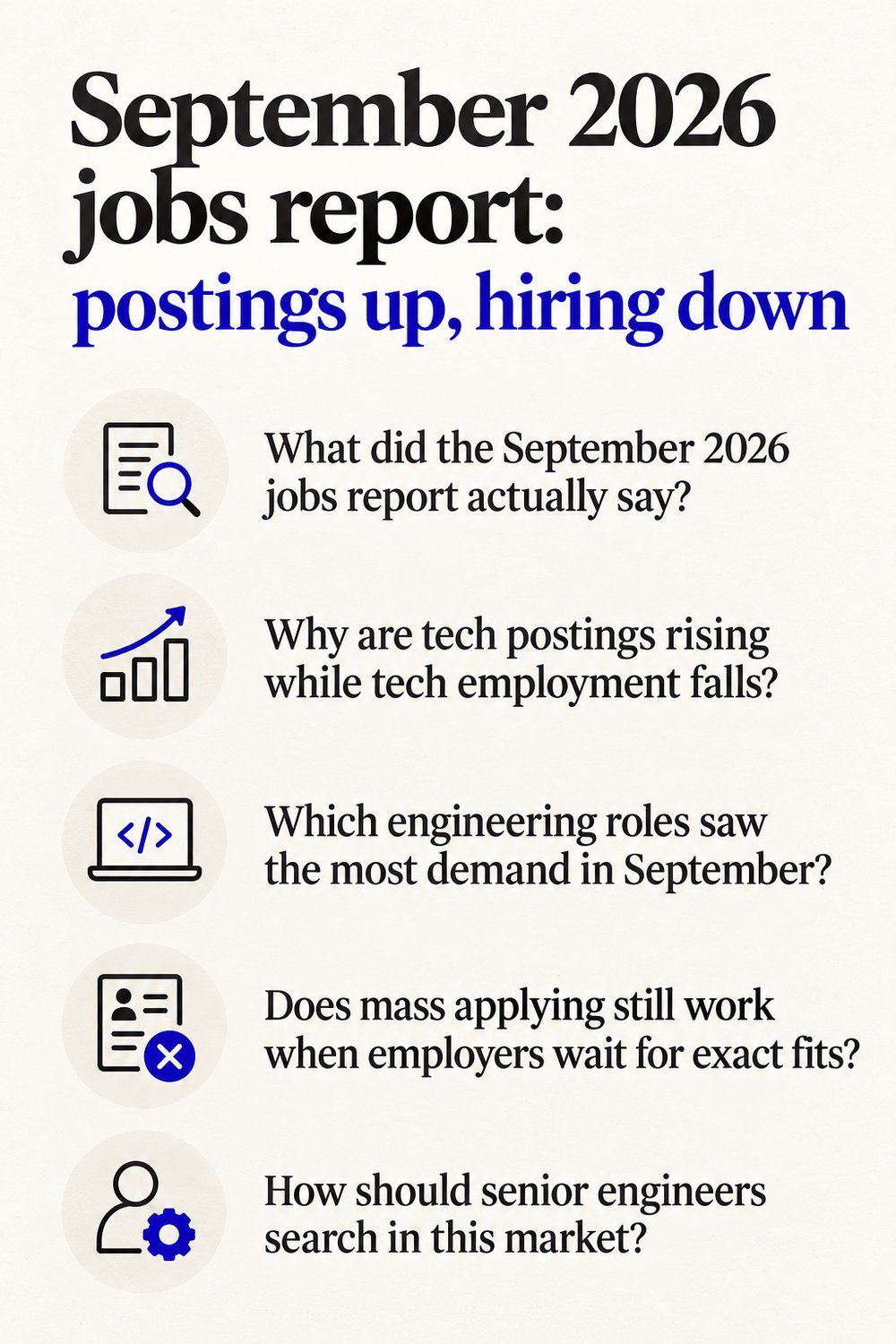
Why are tech postings rising while tech employment falls?
Employers are opening roles faster than they fill them. CompTIA counted 625,633 active postings in September, up 22.4% year over year, while tech sector employment fell by an estimated 10,350 positions. New IT postings alone hit 272,040, up 16%.
An active posting is a job listing that's still open on the date it's counted, whether it went up this month or earlier. Lots of open listings plus shrinking headcount points to reqs sitting unfilled. Hiring managers pass on near-misses and keep waiting.
Glassdoor chief economist Daniel Zhao, quoted by CFO Dive, described the employer view this way. "This can be an environment where it's beneficial to try to find talent that would be too hard to compete for in a hotter job market." Flip that around. If you're the hard-to-get engineer they've been holding out for, you have room to hold your number.
Tech unemployment sat at 3.3%, under the national 4.2%. So the pool of out-of-work tech talent is smaller than the headline suggests, and fit counts for more than volume.
Which engineering roles saw the most demand in September?
Software developers and engineers topped CompTIA's list. They had 47,598 new openings, up 8.3% from August. Systems engineers ranked second, followed by tech support specialists, data analysts and DevOps engineers.
AI is where the slope gets steep. CompTIA found 349,821 active postings requiring AI skills, about 282% growth from its earlier comparison point, plus 13,636 dedicated AI/ML postings, nearly triple that earlier level. Dice's September report, using Lightcast data, put AI/ML tech postings up 88% year over year. That's about five times the 17% growth for tech postings overall.
Pay follows. Robert Half's September write-up found 72% of employers offering higher pay for AI skills. For ML platform engineers, and for backend or platform engineers who've built AI infrastructure, that's the line to make obvious on a profile, in plain words a recruiter can match.
Does mass applying still work when employers wait for exact fits?
For senior roles, rarely. A hiring manager willing to leave a req open instead of settling won't be swayed by your two-hundredth near-miss application. They'll pass on it, quietly.
Auto-apply is a type of job search software that submits applications on your behalf, in bulk, without you reviewing each role. The pitch is volume. The cost is control. Your name reaches employers you never vetted, and a search you meant to keep quiet stops being quiet.
Big job boards have the opposite problem. Even with LinkedIn's AI search replacing the classic one, you're still sorting a long, noisy list by hand. If you're weighing tools built for managing a large active search, our side-by-side with Teal covers where a candidate agent fits instead.
How should senior engineers search in this market?
Narrow first, then move fast on the few roles that clear your bar. Here's the order that suits a market where employers are picky and AI skills carry a premium.
- Set a compensation floor before you open a single listing. A compensation floor is a minimum pay number that screens out any role paying less. If you're targeting $150K+, write that down and don't negotiate against yourself later.
- Choose one location mode, whether remote, hybrid, onsite or a short list of specific cities, and stop relitigating it every time a shiny onsite role appears.
- Fix what's weak before a recruiter sees it. Checking your resume for weak spots catches vague scope and buried AI work. Those gaps turn an exact fit into a near-miss.
- Aim for 3 to 5 strong fits. Each one gets a tailored story; none gets a template.
- Approve every introduction yourself, so no employer sees your profile before you've read the role, the company and the posted range.
- Rehearse the loop before it's real. Coding, system design and behavioral rounds all count, and if a screen uses an automated interviewer, our guide to prepping for HackerRank's AI interviewer walks through it.
What does a Prepin search look like in a market like this?
Fewer roles, each one checked against your floor. An AI candidate agent is a job search tool that builds your profile from a conversation and contacts employers only with your approval.
Prepin starts with one voice conversation about your goals, strengths and dealbreakers. That gets combined with your LinkedIn and resume into one structured profile, with skill checks and assessment evidence sitting next to it instead of resume claims alone. You set a location mode and a compensation minimum once, and your inbox shows matched roles with company, location and posted compensation range. Nothing goes to an employer until you press approve.
The agent runs three workflows: best-fit role matches, recruiter outreach and interview practice. With 625,633 tech postings live in September, the filter matters more than the firehose. Prepin never auto-applies or sends your profile without your permission, and you can build yours at prepin.ai.
Frequently asked questions
- Is the 4.2% unemployment rate a bad sign for senior tech job seekers?
- Not on its own. CompTIA put the tech unemployment rate at 3.3% in September, below the national 4.2%, and active tech postings reached 625,633. The harder part for senior engineers is fit. Employers have openings but look willing to wait for the right person, so a sharp profile and a clear pay floor matter more than application count.
- Do AI skills actually raise pay for backend and platform engineers?
- The September data points that way. Robert Half reported 72% of employers offering higher pay for AI skills, and Dice found AI/ML postings grew 88% year over year. If you've built model serving, data pipelines or ML platform work, name it plainly on your profile so matching picks it up instead of burying it under general backend experience.
- Is a candidate agent that requires approval safer than an AI apply bot?
- For a quiet search while employed, yes. An apply bot sends applications without you reviewing each role, so your name can reach employers you never chose. Prepin never auto-applies or sends your profile without your permission, and you approve every employer introduction before it goes out, after seeing the company, location and posted compensation range.
- How many roles should a senior engineer pursue at once in this market?
- Fewer than you'd think. Prepin is built for finding 3 to 5 strong fits, and the September numbers suit that approach, since employers look willing to wait instead of settling. A handful of tailored conversations, each above your compensation floor and in your location mode, leaves time to prepare properly for coding, system design and behavioral rounds.
Keep reading
HackerRank AI interviewer is live: how to prep
The HackerRank AI interviewer, Chakra, merges three rounds into one scored sitting. Here's how to narrate tradeoffs and AI use so the transcript earns you a 3.
· 6 min read
LinkedIn AI job search replaces classic: what now?
LinkedIn AI job search is replacing classic keyword search with no salary filter. What changes for engineers, and why Prepin's pay floor and approve step help.
· 7 min read
Prepin vs Teal for active job seekers
Prepin vs Teal: Teal tracks and polishes applications you already found. Prepin finds the roles that fit and sends no employer intro until you approve it.
· 4 min read
Prepin vs Wellfound for startup job search
Prepin vs Wellfound: one is a board you apply through yourself, the other brings matched roles and sends no intro until you approve it. Here's how they differ.
· 5 min read