AI mock interview practice vs peer mocks vs coaches
AI mock interview practice wins on reps and availability for coding, system design and behavioral rounds. See where peers and coaches still fit in your prep.
 Prepin Founder6 min read
In short
AI mock interview practice is the better default for most engineers because you can run coding, system design and behavioral reps whenever you're free, without booking anyone. Peers and coaches are best saved for a final human read on delivery once the basics are solid. Prepin puts AI practice next to role matches and approved introductions in one candidate agent.
AI mock interview practice beats peer mocks and paid coaches on what matters most before a loop. Reps you can run whenever you're free, across coding, system design and behavioral rounds. Prepin builds that practice into its candidate agent.
Humans still have a job. A smaller one, later.
What does AI mock interview practice do better than a human?
AI practice wins on volume and availability. A mock interview is a rehearsal round that puts you in front of a stand-in interviewer. With a model in that seat, you can run the round again the moment you finish.
Interview skill mostly comes from repetition. Explaining a tradeoff out loud gets better with reps. So does recovering after a wrong first approach, or keeping a behavioral story from wandering off. Humans can't hand you reps in bulk.
A peer mock is a practice interview that another engineer runs for you, usually in exchange for a turn on the other side. Two calendars have to line up for it. Coaching needs a booking and a fee. An AI session needs a quiet room and whatever evening you have left after work.
Cheap reps also change what you practice. You stop saving sessions for the questions you're scared of and drill your weakest round until it isn't.
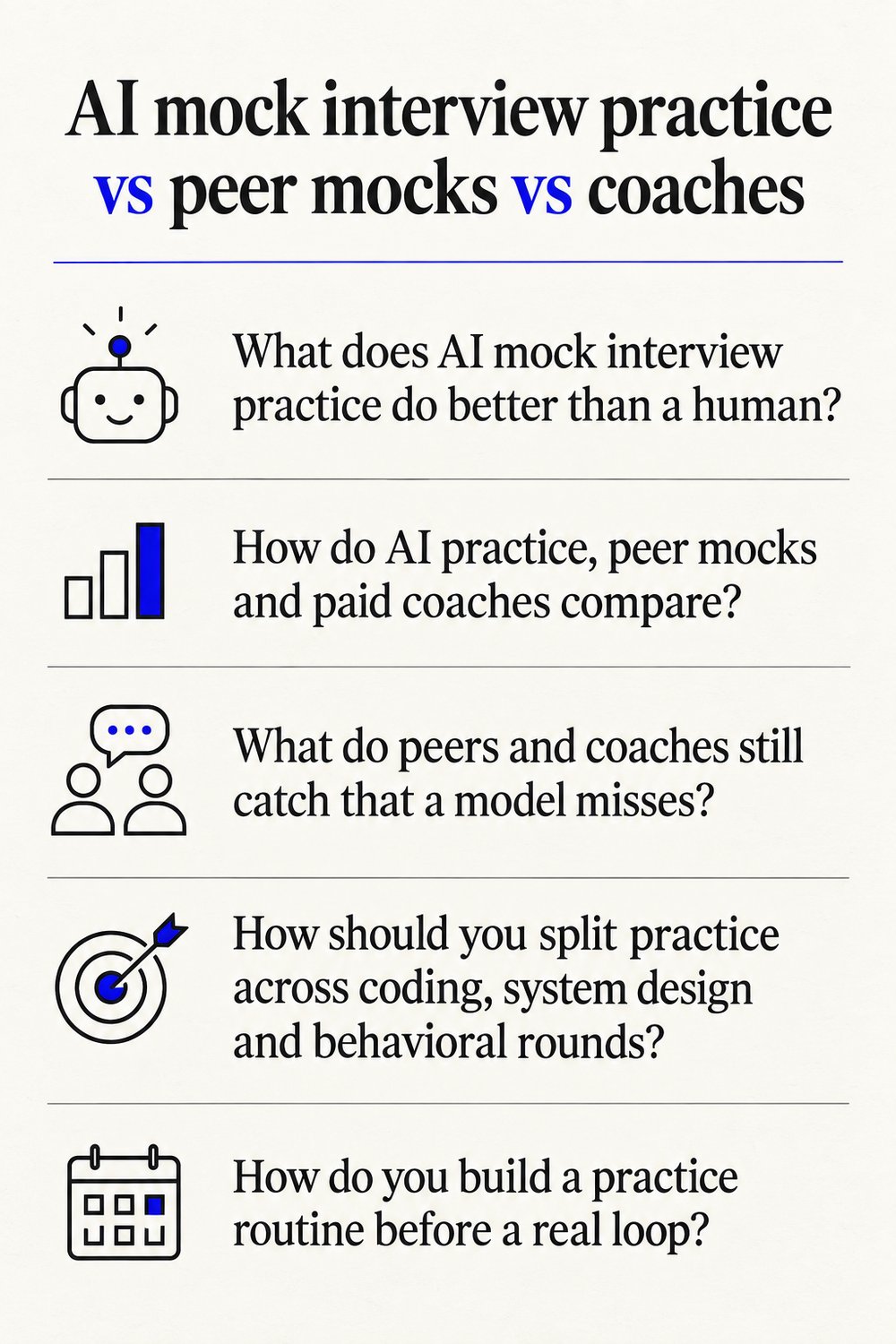
How do AI practice, peer mocks and paid coaches compare?
AI practice leads on scheduling and repetition, and it covers all three round types. Peers and coaches add a human read on delivery, which is worth paying for once the fundamentals are fixed.
| Option | Scheduling | Repetition | Cost model | Rounds covered | Best used for |
|---|---|---|---|---|---|
| Prepin AI mock interview practice | None, run it when you're free | Built for repeated reps | One of three workflows in the Prepin candidate agent | Coding, system design, behavioral | Daily reps and fixing your weakest round before a real loop |
| Peer mocks | Two calendars have to line up | Limited by a friend's free evenings | No cash, paid back by interviewing them in return | Whatever your peer knows well | A human read on how you communicate |
| Paid coaches | Booked sessions | Limited by budget | Per-session or package fees | The coach's specialty | Final polish before a high-stakes loop |
A note on how we compared. This table covers how each option works, not what it costs in dollars. Coach rates vary so widely by seniority and specialty that any single figure would mislead you, so we left prices out.
What do peers and coaches still catch that a model misses?
They catch how you come across to another person. A peer who has sat on a hiring panel can tell you that your design was sound but you never checked in with the interviewer. A coach can hear that your conflict story makes you sound like the difficult one.
Those are judgment calls about tone and reading the room, so keep a few human sessions in the plan. Just spend them well. If a coach's hour goes to a hash map question you'd have fixed alone after a handful of AI reps, you paid for feedback a model gives you on demand. Do the reps first, then bring humans the problems only a human can see.
How should you split practice across coding, system design and behavioral rounds?
Put most of your AI reps into whichever round is weakest, and hold human sessions for the round with the highest stakes at your target level. For senior engineers that usually means system design or behavioral.
A system design interview is a round that asks you to design a service out loud while weighing tradeoffs like storage, scaling and failure handling. A behavioral interview is a round that tests how you've handled real situations through stories about ownership, conflict and failure.
- Coding reps with AI build the habit of narrating your approach before you type, plus the calmer skill of backing out of a wrong first idea. A peer helps if the company runs live pairing.
- For system design, AI reps give you a repeatable structure and the vocabulary for tradeoffs. Bring in a senior peer or coach to judge whether your depth matches the level you're interviewing for.
- Behavioral stories tighten fast with AI reps, since each one needs a clear problem, your specific action and a result. A human can then tell you whether you sound like someone they'd want on the team.
How do you build a practice routine before a real loop?
Start from the actual loop, find your weakest round with AI, fix it with reps, then use human time to check delivery.
- Find out which rounds the company runs and at what level, from the recruiter or the job posting.
- Run one cold AI rep of each round with no prep. The worst one is your starting point.
- Drill that round with AI reps until your structure stops changing from one attempt to the next.
- Book a peer or coach for the same round and ask them to focus on delivery, since the model already covered correctness.
- Take what they flagged back into AI reps and fix it.
- In the final days before the loop, switch to light reps of all three rounds so nothing feels cold.
Why does interview practice belong inside a job search agent?
Practice pays off most for a role you're actually about to interview for, and a job search agent already knows which roles those are. A candidate agent is an AI assistant that works for the job seeker, building the profile, finding matching roles and preparing introductions for approval.
Here's the order Prepin runs things in. You start with one voice conversation about goals, strengths and dealbreakers. Prepin combines it with your LinkedIn and resume into one structured profile, and a check on what's weak in your profile happens before any recruiter reads it. Matched roles land in your inbox with company, location and posted compensation range.
From there the agent runs three workflows: best-fit role matches, recruiter outreach, and interview practice across coding, system design and behavioral rounds. That puts your practice in the same place as the roles you're preparing for. Skill checks and assessment evidence sit alongside a profile recruiters see only on your terms, so an interviewer has more to go on than resume claims.
| Prepin detail | What it means for you |
|---|---|
| Profile sources | 3: LinkedIn, resume and one voice conversation |
| Agent workflows | 3: best-fit role matches, recruiter outreach, interview practice |
| Practice rounds | Coding, system design, behavioral |
| Search setup | Location mode (remote, hybrid, onsite, specific cities) plus a compensation minimum |
| Introductions | Nothing goes to an employer until you approve it |
| Where it works best | Finding 3 to 5 strong fits |
Product details current as of 2026-09-30.
Why do fewer applications make each practice rep count?
A short list raises the stakes of every loop. Prepin's best use is finding 3 to 5 strong fits, so you walk into a handful of interviews you actually want, with time to prepare for each one properly.
That's who this is for. Experienced backend, platform, ML and AI engineers, many targeting $150K+ and remote or hybrid roles, who'd rather prep hard for a few loops than skim through hundreds of postings. If you're still weighing boards, matching services and apply bots, our side-by-side of job search tools for engineers walks through the tradeoffs.
Control matters too, especially if you're employed. Prepin's rule is short: "It never auto-applies or sends your profile without your permission." That lets you run a quiet search while you still have a job and practice for loops nobody at your current company hears about.
Set your location mode and compensation minimum once, then practice for the loops you choose at prepin.ai. Nothing goes to an employer until you press approve.
Frequently asked questions
- Can AI mock interview practice replace a paid interview coach?
- For most of your prep, yes. AI reps handle the volume work: structuring system design answers, narrating coding solutions and tightening behavioral stories. A coach earns their fee as a final check on delivery before a high-stakes loop, and that hour goes much further when the fundamentals were already fixed with AI practice.
- How do I know I've done enough system design reps?
- Watch your structure. When your opening questions, component breakdown and tradeoff discussion stop changing from one AI rep to the next, the structure is solid. From there, shift to delivery: pacing, checking in with the interviewer and going deeper where the level calls for it. That last part is where a senior peer's read helps most.
- Is AI interview practice useful for senior engineers or mainly for new grads?
- Senior engineers arguably get more from it, because senior loops lean on system design and behavioral rounds where structure and storytelling decide the outcome. Those skills improve with repetition. Prepin's interview practice covers coding, system design and behavioral rounds, and it sits next to role matches for experienced backend, platform, ML and AI engineers.
- Will employers see my profile while I practice on Prepin?
- Not unless you approve an introduction. Prepin puts it plainly: "It never auto-applies or sends your profile without your permission." You can practice, review matched roles with their company, location and posted compensation range, and decide later which introductions go out. That keeps a search quiet while you're still employed.
- #ai mock interview practice
- #system design interview practice
- #coding interview practice
- #behavioral interviews
- #software engineers
Keep reading
HackerRank AI interviewer is live: how to prep
The HackerRank AI interviewer, Chakra, merges three rounds into one scored sitting. Here's how to narrate tradeoffs and AI use so the transcript earns you a 3.
· 6 min read
A candidate profile recruiters can see, on your terms
A candidate profile recruiters can see works best when it's built from one conversation. Prepin combines LinkedIn, resume and voice, and holds each intro.
· 4 min read
Job search tools for software engineers, compared
Job search tools for software engineers fall into four categories, from trackers and ATS scanners to auto-apply bots and candidate agents. Which fits you?
· 6 min read
LinkedIn AI job search replaces classic: what now?
LinkedIn AI job search is replacing classic keyword search with no salary filter. What changes for engineers, and why Prepin's pay floor and approve step help.
· 7 min read